Strategic attention: the skill to block out distractions and focus on what's important. Exercises might include taking stock of your environment, identifying what distracts you and eliminating or limiting those things, and creating daily priority lists.Using the mind to heal the brain...
Integrated reasoning: the ability to find the message or theme in what you are watching, reading or doing. Exercises might include making a point of reflecting on the meaning of a book after you've read it or a movie after you've seen it and writing down your interpretation.
Innovation: the vision to identify patterns and come up with new ideas, fresh perspectives and multiple solutions to problems. Exercises might include thinking of multiple solutions to problems as they come up, talking to other people to get a different perspective and taking time to step away from a problem to give yourself an opportunity for creative thoughts.
Hayner says his sessions - he attended for two months and completed take-home exercises - proved invaluable.
"I have been on so many drugs and medications, and they got me nowhere," he says. "Adults with TBIs (traumatic brain injuries) tend to become overwhelmed, and when someone becomes overwhelmed, it spirals into fear and chaos, and we have a tendency to shut down.
"Today as long as I stick to what I was taught here about filtering information and innovative thinking and what's important and what's not important and apply that to my real life, things don't confuse and baffle me ... I can make a decision on the important things that have to be done each day."
17 March 2010
More on brain healing, learning
A McClatchy story by Nancy Churnin ran today in the Oregonian entitled "Scientists rethinking the brain" - couldn't find it on their website, but found it on the Taiwan News site. News of interest concerns a man who was thought to have permanent damage with regard to "his ability to talk to people and stay on task". He was helped by a set of exercises on attention and reasoning.


15 March 2010
Yoga at elementary school in Portland
Ran across this interesting tidbit in a cover story of the Oregonian today: "Portland's Lent School helps disadvantaged students soar" by Betsy Hammond, on the positive results at a local elementary school. Yoga is mentioned on the front page, but in the story itself there's just a bit more on it:
But the school also engages students in hands-on science from the earliest grades. And every elementary student gets art lessons, drama or music class and library time with a specialist each week. Some even have regular yoga lessons to help them relax and feel successful.I'd be interested in knowing more about the yoga program - how many kids are in it, do they self-select, how often do they go, etc.
Finding Consciousness in the Brain?
This short article "Can You Find Consciousness in the Brain?" by Ray Tallis raises some of the philosophical problems of the quest.
Thus measurement takes us further from experience and the phenomena of subjective consciousness to a realm where things are described in abstract but quantitative terms. To do its work, physical science has to discard “secondary qualities”, such as colour, warmth or cold, taste – in short, the basic contents of consciousness. For the physicist then, light is not in itself bright or colourful, it is a mixture of vibrations in an electromagnetic field of different frequencies. The material world, far from being the noisy, colourful, smelly place we live in, is colourless, silent, full of odourless molecules, atoms, particles, whose nature and behaviour is best described mathematically. In short, physical science is about the marginalisation, or even the disappearance, of phenomenal appearance/qualia, the redness of red wine or the smell of a smelly dog.
Consciousness, on the other hand, is all about phenomenal appearances/qualia. As science moves from appearances/qualia and toward quantities that do not themselves have the kinds of manifestation that make up our experiences, an account of consciousness in terms of nerve impulses must be a contradiction in terms. There is nothing in physical science that can explain why a physical object such as a brain should ascribe appearances/qualia to material objects that do not intrinsically have them.
14 March 2010
What is determined?
I recently came across this book description:
Likewise, computers are constrained by operating on particular chips. Does this mean that we can predict everything that is possible to do with computers?
And our brains operate with neurons and bio-chemical reactions, etc. Does this mean that we can predict all that is possible with our minds? I think not. We need to experiment to see what is possible.
In If Not God, Then What? theoretical neuroscientist Joshua Fost shows how the search for beauty is the source of both religious experience and scientific theorizing. The pleasure of seeing a beautiful face, the thrill of understanding a new idea, the sublimity of art and the power of religious transformation are all, in the end, the result of a brain that wants to make sense of the world. Weaving ideas from brain science and everyday activities, from Sunday cartoons to existentialism, Fost shows how a biological idiosyncrasy motivates them all. But if religious experience is just a special activity pattern in neurons, what should we think about its undeniable and emotionally transformative power? If everything we do is determined by physics, what is the basis for free will, or ethics? Blending receptivity to the glory of spiritual exultation with an insistence on naturalistic foundations, If Not God, Then What? breaks new ground and gives its readers insight into a compelling new worldview.The phrase I found most troubling is "If everything we do is determined by physics..." - this just seems wrong to me as a proposition. The laws of physics constrain what is possible, but they do not seem to determine or predict what is possible. Do the laws of physics determine that the boiling point of water is at 100 Centrigrade? I don't think so. In fact we don't know very much about the actual properties of substances until we experiment.
Likewise, computers are constrained by operating on particular chips. Does this mean that we can predict everything that is possible to do with computers?
And our brains operate with neurons and bio-chemical reactions, etc. Does this mean that we can predict all that is possible with our minds? I think not. We need to experiment to see what is possible.
Critique of 'Scientism'
I think this passage sums up my feelings about the extreme materialist views that seem common in neuroscience. It's from 'Blinded by Scientism' by Edward Feser.
Just because there are firing neurons, etc. does not mean that that's the only level of interesting phenomena underlying 'mind' - in fact I think in many ways this is the least interesting level! Not to say that there aren't interesting findings coming from brain studies - of course there are - but there are limits to what can be discovered when looking from the 'outside' of the mind.
The irony is that the very practice of science itself, which involves the formulation of hypotheses, the weighing of evidence, the invention of technical concepts and vocabularies, the construction of chains of reasoning, and so forth—all mental activities saturated with meaning and purpose—falls on the “subjective,” “manifest image” side of scientism’s divide rather than the “objective,” “scientific image” side. Human thought and action, including the thoughts and actions of scientists, is of its nature irreducible to the meaningless, purposeless motions of particles and the like. Some thinkers committed to scientism realize this, but conclude that the lesson to draw is not that scientism is mistaken, but that human thought and action are themselves fictions. According to this radical position—known as “eliminative materialism” since it entails eliminating the very concept of the mind altogether instead of trying to reduce mind to matter—what is true of human beings is only what can be put in the technical jargon of physics, chemistry, neuroscience and the like. There is no such thing as “thinking,” “believing,” “desiring,” “meaning,” etc.; there is only the firing of neurons, the secretion of hormones, the twitching of muscles, and other such physiological events. While this is definitely a minority position even among materialists, there are those who acknowledge it to be the inevitable consequence of a consistent scientism, and endorse it on that basis. But as Hayek would have predicted, the very attempt to state the position necessarily, but incoherently, makes use of concepts—“science,” “rationality,” “evidence,” “truth,” and so forth—that presuppose exactly what the position denies, viz. the reality of meaning and mind.
Just because there are firing neurons, etc. does not mean that that's the only level of interesting phenomena underlying 'mind' - in fact I think in many ways this is the least interesting level! Not to say that there aren't interesting findings coming from brain studies - of course there are - but there are limits to what can be discovered when looking from the 'outside' of the mind.
12 March 2010
What is Mind?
Let's see what Wikipedia has to say about Mind:
"Mind is the aspect of intellect and consciousness experienced as combinations of thought, perception, memory, emotion, will and imagination, including all unconscious cognitive processes. The term is often used to refer, by implication, to the thought processes of reason. Mind manifests itself subjectively as a stream of consciousness."
This seems useful enough. The key, I believe, is that mind is subjective. The issue of conscious faculties versus unconcious ones is worth considering.
"Mind is the aspect of intellect and consciousness experienced as combinations of thought, perception, memory, emotion, will and imagination, including all unconscious cognitive processes. The term is often used to refer, by implication, to the thought processes of reason. Mind manifests itself subjectively as a stream of consciousness."
This seems useful enough. The key, I believe, is that mind is subjective. The issue of conscious faculties versus unconcious ones is worth considering.
07 March 2010
The Mind and the Brain
I’ve been reading a number of things lately about the mind (our subjective experience) and the brain, and how they inter-relate. Some scientists seem perfectly comfortable with simply stating that the mind can be equated to brain-states, and this may be true (I don’t think we really know, though the scientific position rejects the dualistic approach that posits the mind as something more or different from the brain). But even so, certainly my experience of mind is not an experience of brain-states, it is about concepts like attention, memory, feeling, etc. I am particularly interested in scientific study of how intentional mind-states have impact on the brain (and thus have known physical effects), even if we don’t really understand what ‘attention’ actually is.
Here’s some material from a book I’ve been reading called Train Your Mind Change Your Brain by Sharon Begley which reports on some recent neuroscience findings (it’s in fact a summary of findings that were presented to the Buddhist community including the Dalai Lama in a series of workshops). Many of the findings are with regard to neuroplasticity, the ability of the brain to change in response to various stimuli. But this one stuck out in my mind (page 158):
Now in some ways this finding seems completely obvious. Clearly when we’re in school, we tend to learn those things which we pay attention to… if you attend a foreign language class and don’t pay attention, you may pick up a few words, but will not learn much. This just confirms that there’s an actual physical result from the conscious attention. The interesting questions to me are what techniques can be used to direct attention in the most effective way to achieve one’s goals and desires.
Also it seems to me that as more brain resources are trained on particular tasks, the task moves from one that requires conscious attention to being more of a background, autonomous process, allowing the conscious attention to move to other areas.
Here’s some material from a book I’ve been reading called Train Your Mind Change Your Brain by Sharon Begley which reports on some recent neuroscience findings (it’s in fact a summary of findings that were presented to the Buddhist community including the Dalai Lama in a series of workshops). Many of the findings are with regard to neuroplasticity, the ability of the brain to change in response to various stimuli. But this one stuck out in my mind (page 158):
Attention is also, as it happens, indispensable for neuroplasticity. Nowhere was that shown more dramatically than in one of Mike Merzenich’s experiments with monkeys. The scientists rigged up a device that tapped the animals’ fingers one hundred minutes a day every day for six weeks. At the same time as this bizarre dance was playing on their fingers, the monkeys listened to sounds over headphones. Some of the monkeys were taught, pay attention to what you feel on your fingers, such as when the rhythm changes, we’ll reward you with a sip of juice; don’t pay attention to the sounds. Other monkeys were taught, pay attention to the sound, and if you indicate when it changes, you’ll get juice. At the end of six weeks, the scientists compared the monkeys’ brains. Let me underline that every monkey, whether trained to pay attention to what it was hearing or what it was feeling on its fingers, had the exact same physical experience – sounds coming in through headphones plus taps on its fingers. The only thing that made one monkey different from another was what it paid attention to.It goes on to state that the stimuli that was attended to produced more brain resources going to that stimuli, and not to the one that was ignored. So in some sense it appears that ‘attention’ can be a part of what shapes our brain, and that since we can direct our attention, there may be ways to consciously direct the development of brain resources.
Usually, when a particular spot on the skin suddenly begins receiving unusual amounts of stimulation, its representation in the somatosensory cortex expands. That was what Mike Merzenich discovered in his monkeys. But when the monkeys paid attention to what they heard rather than to what they felt, there was no change in the somatosensory cortex – no expension of the region that handles input from the finger feeling the flutter.
Now in some ways this finding seems completely obvious. Clearly when we’re in school, we tend to learn those things which we pay attention to… if you attend a foreign language class and don’t pay attention, you may pick up a few words, but will not learn much. This just confirms that there’s an actual physical result from the conscious attention. The interesting questions to me are what techniques can be used to direct attention in the most effective way to achieve one’s goals and desires.
Also it seems to me that as more brain resources are trained on particular tasks, the task moves from one that requires conscious attention to being more of a background, autonomous process, allowing the conscious attention to move to other areas.
11 February 2010
'Natural Born Cyborgs' by Andy Clark (2003)
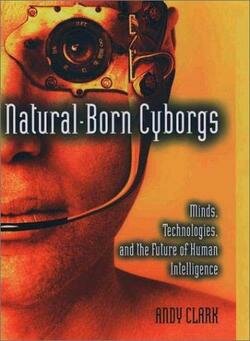
1. On language:
“The deepest contributions of speech and language to human thought, however, may be something so large and fundamental that it is sometimes hare to see it at all! For it is our linguistic capacities, I have long suspected, that allow us to think and reason about our own thinking and reasoning. And it is this capacity, in turn, that may have been the crucial foot-in-the-door for the culturally transmitted process of designer-environment construction: the process of deliberately building better worlds to think in.” (p. 78). What he’s getting at here is language as a tool that gives us the ability to examine concepts and generate ideas that could not have been conceived of without language.
In a somewhat similar fashion he mentions how we use mathematical shortcuts and paper-based tools to, for example, multiply two large numbers, like 147 * 382. Most of us cannot do that calculation in our heads, but with a piece of paper and a pencil and the mental math tools of breaking the problem down into simple integer multiplication (7 * 2, then 7* 8, etc.) we can solve the problem. So is the calculation simply in our head, or is it in fact a collaboration of brain and pencil and paper (or these days brain and calculator). The tools expand our mental universe, give us access to areas that we could not get to without them.
2. On extended mental worlds, Alzheimer’s example:
“These patients were a puzzle because although they still lived alone, successfully, in the city, they really should not have been able to do so. On standard psychological tests they performed rather dismally. They should have been unable to cope with the demands of daily life. What was going on? A sequence of visits to their home environments provided the answer. These home environments, it transpired, were wonderfully calibrated to support and scaffold these biological brains. The homes were stuffed full of cognitive props, tools and aids. Examples included message centers where they stored notes about what to do and when; photos of family and friends complete with indications of names and relationships; lables and pictures on doors; [etc.]” (p. 140).
Here again he is making the point that we put ‘intelligence’ out in our environment, and our brains and bodies work with these tools to make sense of the world. Note that none of this involves ‘biological implants’ but in principle these too are tools that can feed us more useful information, just the way a cane can provide information to a blind person.
3. The extended mind:
“What we really need to reject, I suggest, is the seductive idea that these various neural and nonneural tools need a kind of privileged user. Instead, it is just tools all the way down. Some of those tools are indeed more closely implicated in our conscious awareness of the world than others. But those elements, taken on their own, would fall embarrassingly short of reconstituting any recognizable version of a human mind or an individual person. Some elements, likewise are more important to our sense of self and identity than others. Some elements play larger roles in control and decision making than others. But this divide, like the ones before it, tends to crosscut the inner and the outer, the biological and the nonbiological.” (p 137).
“Tools-R-Us. But we are prone, it seems, to a particularly dangerous kind of cognitive illusion. Because our best efforts at watching our own minds in action reveal only the conscious flow of ideas and decisions, we mistakenly identify ourselves with the stream of conscious awareness.” (p. 137).
There is plenty more to chew on in this book. This argument about the extended mind is similar to the points made by Alva Noe in his book Out of Our Heads.
Subscribe to:
Posts (Atom)


